What Is a Liftgate?
A liftgate is a mechanical loading platform installed on the rear or side of a truck, trailer or delivery van. It lifts cargo between ground level and the vehicle bed, so freight can be loaded or unloaded without a loading dock or forklift.
In freight and delivery work, a liftgate is often used for palletized goods, appliances, machinery, building materials, medical equipment, tires, food service goods and other heavy items. The goal is not to replace every forklift. The goal is to make loading possible at places where fixed lifting equipment is not available.
Many people see the platform first, but the platform is not the whole system. A working liftgate also includes a frame, arms or rails, hydraulic cylinders, a power unit, control switches, wiring and safety parts. For the hydraulic source behind the platform, see Hydrath hydraulic liftgate pump options.

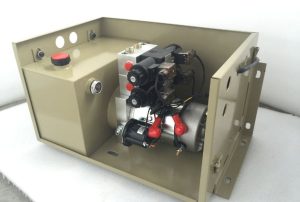 Liftgate Power Unit
How Does a Hydraulic Liftgate Work?
A hydraulic liftgate works by turning battery power into hydraulic pressure. The operator presses an up/down switch, pendant or wireless remote. That signal energizes a relay or solenoid, starts a DC motor, and the motor drives a hydraulic pump. The pump draws oil from the reservoir and sends pressurized oil through a valve block to one or more cylinders. The cylinders extend or retract, moving the platform.
The basic lifting sequence is:
- The operator presses the lift control.
- The control circuit starts the DC motor.
- The motor turns the gear pump.
- The pump sends oil from the tank into the hydraulic circuit.
- Oil pressure moves the cylinder piston.
- The cylinder moves the platform, arms or rails.
- A relief valve limits maximum pressure.
- When lowering, a valve meters oil back to the tank.
In a single acting liftgate, hydraulic pressure raises the platform and gravity lowers it through a controlled valve. In a double acting or power up/power down liftgate, hydraulic pressure controls both directions. The right circuit depends on the liftgate design, load behavior, required lowering control and safety requirements.
Main Components of a Truck Liftgate
| Component | What It Does | Why It Matters |
|---|
| Platform | Carries the load during lifting and lowering | Size and rated capacity must match cargo and handling tools |
| Frame | Mounts the liftgate to the truck or trailer | Installation strength affects safety and service life |
| Arms or rails | Guide platform movement | Tuck-under, rail and cantilever gates use different geometry |
| Hydraulic cylinders | Convert oil pressure into motion | Bore, stroke and quantity affect force and oil volume |
| DC motor | Drives the hydraulic pump | Voltage and duty cycle affect current, heat and reliability |
| Gear pump | Creates hydraulic flow | Flow affects platform speed |
| Reservoir | Stores hydraulic oil | Tank size affects oil supply, heat and air release |
| Valve block | Controls oil direction and pressure | Includes relief, check, lowering or directional valves |
| Controls | Sends operator commands | Can be fixed switch, wired pendant or wireless remote |
| Battery wiring | Feeds high current to the motor | Cable size, fuse and grounding affect voltage drop |
The power unit is the compact assembly that usually combines the motor, pump, tank and valves. Hydrath’s DC hydraulic power pack family is designed for mobile equipment where battery power and compact mounting space are required.
Common Types of Liftgates
| Liftgate Type | Best Fit | Main Advantage | Main Tradeoff |
|---|
| Tuck-under liftgate | Box trucks and dock-heavy routes | Stores under the body and keeps rear access clear | Needs underbody space and ground clearance |
| Rail liftgate | Heavy street delivery and carts | Large, level vertical platform movement | Can block rear door access when stowed |
| Cantilever liftgate | Uneven ground and larger platforms | Better platform angle control | More complex structure and controls |
| Fold-up liftgate | Simple rear loading platform | Large working surface | Rear access may be blocked when stowed |
| Slider liftgate | Trailers and special bodies | Can move away from loading position | More moving parts and mounting constraints |
The liftgate type changes the hydraulic system. A compact tuck-under gate may need a protected underbody power unit. A rail liftgate may need a stable flow rate for high-cycle delivery. A cantilever gate may need more careful valve logic to control platform angle.
Hydraulic Liftgate Pump and Power Unit Specs
For most truck and trailer liftgates, the hydraulic power unit is a compact DC system. Hydrath liftgate pump configurations commonly include 12V or 24V DC, single acting or double acting circuits, 1.0 to 5.0 L/min flow, pressure up to 16 MPa, 3L to 10L reservoir capacity and wired or wireless remote options.
| Spec | What to Check | Practical Note |
|---|
| Voltage | 12V or 24V DC | Must match the vehicle electrical system |
| Flow | L/min or GPM | Controls lifting and lowering speed |
| Pressure | MPa, bar or psi | Must match load, cylinder size and relief setting |
| Reservoir | Liters or quarts | Must cover cylinder volume and return oil |
| Circuit | Single acting or double acting | Changes valve block and cylinder connections |
| Mounting | Horizontal or vertical | Must fit the truck frame and service access |
| Controls | Fixed, pendant or wireless | Affects operator position and visibility |
| Duty cycle | Cycles per hour or route | Affects motor heat and battery sizing |
Do not select a replacement pump by voltage alone. Two 12V power units can have different motors, flow rates, tank sizes, valve logic, ports and duty cycles.
Single Acting vs Double Acting Liftgate Circuits
| Circuit | How It Works | Good Fit | Notes |
|---|
| Single acting | Hydraulic power raises, gravity lowers through a valve | Common power up/gravity down liftgates | Simple, fewer hoses, lower cost |
| Double acting | Hydraulic power raises and lowers | Power up/power down gates, controlled lowering | More control, more valves and plumbing |
A single acting hydraulic power pack is a common choice when gravity down is acceptable and the platform lowers consistently. A double acting power unit is better when the platform must be powered in both directions, when the motion needs more control, or when the liftgate geometry requires pressure on both sides of the cylinder.
12V vs 24V Liftgate Power Units
Most light trucks, vans and retrofit systems use 12V power. Many commercial trucks and heavier mobile platforms use 24V power. The power unit should follow the vehicle electrical system unless the OEM design intentionally adds a separate battery and charging package.
| Factor | 12V Liftgate Power Unit | 24V Liftgate Power Unit |
|---|
| Common use | Light trucks, vans, small trailers | Commercial trucks and heavier systems |
| Current draw | Higher current for the same motor power | Lower current for the same motor power |
| Cable sensitivity | More sensitive to voltage drop | Better for longer cable runs |
| Availability | Broad aftermarket supply | Common in fleet and OEM systems |
| Main risk | Undersized cables, weak battery, heat | Voltage mismatch with vehicle system |
Hydrath provides both 12V DC hydraulic power pack and 24V DC hydraulic power pack options for mobile equipment. When sizing either one, confirm battery capacity, cable length, fuse rating, grounding, motor duty and charging time between cycles.
How to Choose a Liftgate Pump
Use a specification process instead of guessing from liftgate capacity alone:
- Confirm the vehicle voltage. Match 12V or 24V to the truck electrical system.
- Confirm the liftgate type. Tuck-under, rail, cantilever and fold-up gates use different cylinder layouts.
- Record cylinder data. Include bore, rod, stroke, quantity and oil port size.
- Define the load and speed. Rated capacity, real load center and desired lift time determine pressure and flow.
- Choose the circuit. Decide between single acting gravity down and double acting power down.
- Size the reservoir. Make sure the tank supports cylinder volume, return oil and mounting angle.
- Check controls and wiring. Decide on wired pendant, wireless remote, switch box, fuse, relay and cable size.
This process helps prevent common failures: slow lifting from low flow, failure to lift from low pressure, motor overheating from long duty cycles, and weak performance from undersized wiring.
Safety and Maintenance Notes
Liftgates move heavy loads near workers, vehicles and loading areas. OSHA’s loading and unloading guidance states that workers should be instructed in safe procedures appropriate to the materials they handle. For liftgates, this means rated load awareness, stable cargo placement, clear operator position and training on the specific gate model.
Basic maintenance should include:
- Check hydraulic oil level and visible leaks.
- Inspect cables, battery terminals, fuses and ground connections.
- Check platform hinges, pins, rollers, chains or rails.
- Test up/down controls and emergency stop or cutoff devices if fitted.
- Keep feet, hands and loose cargo clear of pinch points.
- Do not use the platform as a personnel lift unless the equipment is specifically rated and approved for that use.
If a liftgate slows down, stalls, drifts, overheats or makes unusual noise, stop and inspect it before the next delivery route.
OEM RFQ Checklist
| Item | Information to Provide |
|---|
| Vehicle | Truck type, battery voltage and installation space |
| Liftgate type | Tuck-under, rail, cantilever, fold-up or custom |
| Rated load | Capacity and actual working load |
| Cylinder data | Bore, rod, stroke, quantity and port threads |
| Required speed | Lift time, lowering time and cycle frequency |
| Circuit | Single acting or double acting |
| Pressure | Working pressure and relief valve target |
| Flow | Required L/min or GPM |
| Tank | Reservoir size and mounting direction |
| Controls | Switch, pendant, wireless remote or custom control |
| Environment | Rain, road salt, dust, washdown, cold weather |
| Documentation | Drawing, photos, old pump label or hydraulic schematic |
This is the information a manufacturer needs to quote a pump that fits the liftgate, not just the truck model.
Frequently Asked Questions
Is a liftgate the same as a tail lift?
Yes, in many markets the terms refer to the same general equipment. North American users often say liftgate, while UK and EU users often say tail lift. Both describe a loading platform mounted on a vehicle.
Does every truck liftgate use hydraulics?
No. Some smaller vehicle liftgates use electric actuators, and some systems may include pneumatic features. For commercial freight platforms, hydraulic systems are common because they provide high force in compact space.
How much weight can a liftgate lift?
It depends on the model. Some service articles mention common ranges around 1,500 to 3,500 lb, while heavy-duty gates can go higher. Always follow the liftgate manufacturer’s rated capacity and include the weight of carts or pallet jacks.
Why does a liftgate need a battery?
A DC hydraulic liftgate uses vehicle battery power to run the electric motor. The motor drives the pump, and the pump creates hydraulic flow. Weak batteries, long cables or poor grounds can make a good pump perform poorly.
What causes a liftgate to lift slowly?
Common causes include low battery voltage, undersized cables, low oil level, worn pump, restricted hoses, incorrect relief setting, overloaded platform or internal cylinder leakage. Start with safe visual checks before replacing parts.
Can I replace only the liftgate power unit?
Yes, if the platform, cylinders, frame and controls are still suitable. The replacement unit must match voltage, pressure, flow, reservoir, port threads, circuit type and mounting space. A photo of the old label is helpful but not enough by itself.
Closing
A liftgate is a vehicle-mounted loading platform that makes freight handling possible when no dock or forklift is available. The basic motion looks simple, but the working system depends on hydraulic pressure, oil flow, cylinders, valves, controls and battery wiring.
For OEM projects or replacement pumps, treat the hydraulic power unit as a specification item. Voltage, pressure, flow, tank size, circuit type and duty cycle determine whether the liftgate works smoothly in daily service. Hydrath can review 12V/24V hydraulic liftgate pump layouts for trucks, trailers, vans and other mobile lifting equipment.