Introduction: Why System Type Matters
Hydraulic transmission technology is a core component of modern industrial power systems. With high power density, flexible layout, and precise control, hydraulic systems play an irreplaceable role in various mechanical equipment.
Industrial standards guide hydraulic system design. According to ISO 4413:2010, designers shall consider system configuration, efficiency requirements, and operating conditions when selecting hydraulic components.
Open loop and closed loop systems represent two fundamental hydraulic circuit configurations. The choice directly affects equipment performance, efficiency, and cost.
What is an Open Loop Hydraulic System?
In an open loop hydraulic system, the return oil from actuators flows directly back to the tank. The fluid completes an open cycle: pump → actuator → tank.

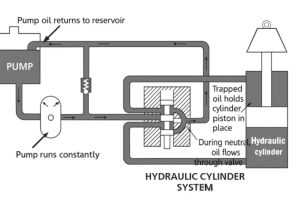 open loop hydraulic system
Main Components
- Power Element: Hydraulic pump (piston, gear, or vane)
- Actuator: Hydraulic cylinder or motor
- Control Elements: Directional, pressure, and flow control valves
- Auxiliary Components: Tank, filters, coolers, pipes
What is a Closed Loop Hydraulic System?
In a closed loop system, the discharge port of the actuator connects directly to the pump inlet. The fluid circulates within a closed circuit: pump → actuator → pump.
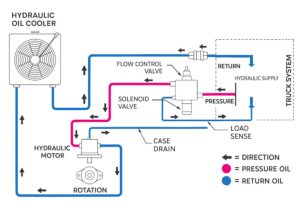 closed loop hydraulic system
Main Components
- Power Unit: Bidirectional variable displacement piston pump
- Actuator: Fixed or variable displacement motor
- Make-up System: Make-up pump, charge relief valve, filters
- Control & Safety: High-pressure relief valves, flush valves
Detailed Comparison
| Feature | Open Loop | Closed Loop |
|---|
| Complexity | Simple, high standardization | Complex, especially variable pumps |
| Space/Weight | Large tank, larger volume | Small tank, compact, high density |
| Efficiency | Lower at medium-high pressure | Higher, especially at partial load |
| Speed Control | Valve control (throttle) | Pump control (displacement) |
| Heat Dissipation | Good (large oil-air contact) | Poor (requires flush valve) |
| Response | Slower, lower precision | Fast, high precision |
| Cost | Lower initial investment | Higher initial investment |
| Maintenance | Easier | Professional required |
When to Choose Open Loop Systems
Open loop systems are ideal when:
- Equipment structure is fixed
- Medium power requirements
- Multiple actuators require distributed operation
- Cost sensitivity is high
Applications: Industrial presses, injection molding, machine tools
When to Choose Closed Loop Systems
Closed loop systems are ideal when:
- Continuous high-power operation required
- Precise speed control is essential
- Space and weight are constrained
- Energy efficiency is a priority
Applications: Mobile equipment (excavators, cranes), vehicle drives
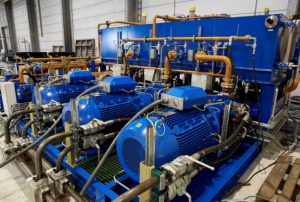 hydraulic system
Frequently Asked Questions
Q: What is the main difference between open loop and closed loop systems?A: In open loop systems, oil returns to the tank after passing through actuators. In closed loop systems, oil circulates directly between the pump and actuator.
Q: Which system has better efficiency?A: Closed loop systems generally have better efficiency, especially at partial load conditions, because they eliminate throttling losses.
Q: Why do closed loop systems need make-up pumps?A: Make-up pumps compensate for internal leakage, provide control oil pressure, and perform partial fluid cooling.
Need Help Choosing a Hydraulic System?
Contact us for system design consultation and component selection.