Introduction: Why Control Hydraulic Cylinder Speed?
The unique characteristic of hydraulic cylinders is their volumetric efficiency approaching 100%, despite losses from mechanical efficiency. This means nearly all fluid entering them produces proportional linear motion, making cylinder speed calculation relatively straightforward.
Industrial standards guide hydraulic design decisions. According to ISO 4413:2010, designers shall consider flow rates and pressure when sizing components for safe operation.
Here are the 5 most common methods to control hydraulic cylinder speed:

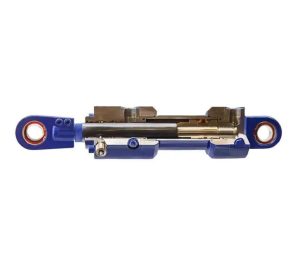 5 Ways to Control Hydraulic Cylinder Speed Flow Control Methods Explained
1 Meter-In Flow Control
The most common method for controlling hydraulic cylinder speed is limiting flow entering the working port. You can install metering flow control valves directly at the work port, in the work line, or at the valve stack or manifold.
Meter-in flow control must include a check valve for free reverse flow. This is critical because the cylinder needs unrestricted flow during the return stroke.
Best for: General speed control applications where load direction is consistent.
2 Meter-Out Flow Control
Contrary to the first method, meter-out flow control restricts fluid flowing out of the cylinder to control speed.
Warning: Pressure Intensification Risk
The old pneumatic saying “when in doubt, meter out” should raise suspicion in hydraulic applications. Meter-out control can cause pressure intensification, leading to leakage or failure.
Never meter out when the rod-side liquid needs to bear the load of a double-acting cylinder. When that pressure is exposed to back pressure, it combines with load pressure, causing rod-side pressure to rise to dangerous levels.
Best for: Applications with light loads where back pressure is not a concern.
3 Needle Valves
In many cases, needle valves are the most effective and cost-sensitive method for controlling cylinder speed.
Without a check valve, needle valves can restrict flow in both directions, making them suitable for applications requiring slow gravity descent.
Best for: Low-speed gravity descent applications, bidirectional speed control.
4 Priority Three-Port Flow Control
This valve has a single inlet and dual outlets, regulating the proportion of flow to both ports. The priority (CF) port is typically pressure compensated.
It determines the flow hierarchy: if input flow falls below the priority flow setting, flow to the third port (EF) becomes unavailable.
Caution: In applications with large inlet flow and low controlled flow, all inlet flow is affected by operating pressure, and excess flow is wasted as heat.
Best for: Systems requiring priority flow to one actuator with overflow to secondary circuits.
5 Proportional Directional Valves
Proportional valves regulate spool position through PWM controllers, achieving variable flow. The spool contains metering grooves providing metered flow, essentially similar to dual needle valves.
Pressure compensation, load sensing, or complex electronic control gives proportional valves superior performance in controlling cylinder speed.
Best for: High-precision applications requiring variable speed control.
Comparison: 5 Speed Control Methods
| Method | Flow Restriction | Best Application | Risk Level |
|---|
| Meter-In | Inlet | General speed control | Low |
| Meter-Out | Outlet | Light load applications | High |
| Needle Valve | Both directions | Gravity descent | Medium |
| Priority Flow Control | Regulated proportion | Multi-actuator systems | Low |
| Proportional Valve | Variable | Precision control | Low |
How to Choose the Right Speed Control Method
- Simple speed control needed? Meter-in with check valve
- Variable load present? Proportional valve with load sensing
- Low-cost bidirectional control? Needle valve (without check valve)
- Priority flow to one actuator? Three-port priority flow control
- High-precision requirements? Proportional valve with PWM control
Frequently Asked Questions
Q: What is the difference between meter-in and meter-out control?A: Meter-in restricts flow entering the cylinder; meter-out restricts flow leaving. Meter-in is generally safer for variable loads; meter-out can cause pressure intensification.
Q: Why do flow control valves need check valves?A: Check valves provide free reverse flow, allowing the cylinder to retract without restriction when the flow control valve is closed.
Q: What causes pressure intensification in meter-out control?A: When outlet flow is restricted, back pressure combines with load pressure on the rod side, potentially exceeding system pressure.