What is a Counterbalance Valve?
A counterbalance valve, sometimes called an overcenter valve, is installed downstream of an actuator to maintain fixed pressure on a load. When a cylinder supports a vertically mounted load and its directional valve moves to lower the load, the load could otherwise push fluid out of the cylinder and drop uncontrollably due to its weight.
Industrial standards guide hydraulic design decisions. According to ISO 4413:2010, designers shall consider maximum pressure and temperature when sizing components. This ensures safe operation and long service life.
Counterbalance valves use pilot signals, typically from the cylinder inlet, to help overcome the spring. Pilot assist makes balancing more efficient and reduces power requirements and heat generation within the system. For extremely low flows, counterbalance valves also function as thermal relief valves.

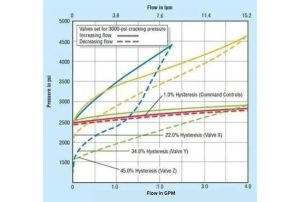 Hysteresis test results for four counterbalance valves. The test demonstrates how dynamic seals introduce friction, causing lag and pressure overshoot in valve response
What is Hysteresis in Counterbalance Valves?
Hysteresis refers to the lag or delay in valve response. Most counterbalance valves have one to three dynamic seals, which introduce friction. This friction causes the valve to stick, resulting in pressure overshoot. The valve then moves to correct itself and compensate for the shortfall.
The consequences of hysteresis include:
- Pressure shocks
- Loud vibrations
- High-frequency squealing
Sometimes this chattering is caused by cylinder design rather than the counterbalance valve itself. The more dynamic seals inside a counterbalance valve, the more severe the hysteresis. If caused by the cylinder, no counterbalance valve in the world can eliminate this chattering.
Counterbalance Valve vs Conventional Relief Valve
| Feature | Counterbalance Valve | Conventional Relief Valve |
|---|
| Primary Function | Load holding + controlled lowering | Overpressure protection |
| Pilot Assist | Yes, from cylinder port | No |
| Seal Count | 1-3 dynamic seals (typical) | 1 seal (typical) |
| Hysteresis Risk | Higher | Lower |
| Response Speed | Slower due to friction | Faster |
| Heat Generation | Higher | Lower |
Advantages and Disadvantages of Different Pilot Ratios
Most counterbalance valves offer pilot ratios ranging from 1.75:1 to 12.0:1.
Pros of Adjustable Pilot Ratio
- Can match specific equipment requirements
- May resolve unstable operation in some cases
- Provides flexibility for different applications
Cons of Adjustable Pilot Ratio
- Trial-and-error selection is time-consuming
- Wrong ratio amplifies hysteresis problems
- Increases energy consumption
Recommended Practice: Based on field experience, a 4:1 pilot ratio counterbalance valve meets most application requirements without trying multiple ratios.
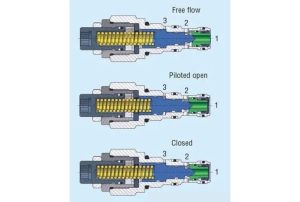 Cross-section view of a counterbalance valve showing flow paths in three operating states. Flow paths are determined by pressure at ports 1, 2, and 3 acting on the pilot valve spool (blue) and che
How to Diagnose Counterbalance Valve Hysteresis
- Check for pressure shocks during load lowering
- Listen for vibrations or squealing near the valve
- Measure response lag between pilot signal and valve operation
- Inspect seal condition if accessible
- Test with different pilot ratios to confirm cylinder vs valve origin
How to Reduce or Eliminate Hysteresis
Symptom Treatment Methods (Temporary Fixes)
- Adjust pilot ratio to match specific equipment
- Use short-stroke or adjustable-stroke valves to restrict flow until stable (increases energy consumption)
- Install a small orifice or accumulator volume in the pilot line to dampen response (sensitive to fluid viscosity; valve may become sluggish at low temperatures)
These quick fixes address symptoms but do not cure the root cause.
Root Cause Solution: Eliminate Dynamic Seals
To eliminate counterbalance valve hysteresis, all dynamic seals must be removed. Counterbalance valves without dynamic seals have virtually no hysteresis. The valve speed is fast enough to follow any input signal, eliminating bouncing, loud noise, and high-frequency squealing.
Because the pilot piston has no seals, a small amount of hydraulic oil leaks from the pilot piston, purging air from the pilot lines and providing warm lubricating oil circulation. This makes the valve extremely responsive. The optimal mounting position for the valve on the cylinder is with the adjustment screw facing down for quick air bleeding from pilot lines and spring chamber.
As with all industry-standard counterbalance valves, rotating the adjustment screw clockwise increases pressure, while counterclockwise rotation decreases pressure.
Frequently Asked Questions
Q: What causes hysteresis in counterbalance valves?A: Dynamic seals create friction, causing the valve to stick and respond slowly. This results in pressure overshoot and lag.
Q: Can hysteresis be completely eliminated?A: Yes, by using counterbalance valves without dynamic seals. These designs eliminate friction at the source.
Q: What pilot ratio should I choose?A: A 4:1 pilot ratio meets most application requirements. Higher ratios provide more holding force but may increase response lag.
Q: Is chattering always caused by the counterbalance valve?A: No. Sometimes cylinder design causes the chattering. No counterbalance valve can fix chattering caused by cylinder issues.
Q: What is the difference between a counterbalance valve and an overcenter valve?A: There is no difference. They are the same component with different names.
Conclusion
Hysteresis is indeed the counterbalance valve’s worst enemy. Dynamic seals create friction that leads to pressure overshoot, vibrations, and noise. While temporary fixes like adjusting pilot ratios can address symptoms, the true solution lies in eliminating dynamic seals entirely.
For applications requiring precise load control, consider counterbalance valves designed without dynamic seals. These offer faster response, reduced noise, and improved energy efficiency.