What Is a Tuck Away Lift Gate?
A tuck away lift gate, also called a tuck-under or stow-away liftgate, folds and stores underneath the truck body when it is not in use. The platform stays out of the rear doorway, so the vehicle can back up to a loading dock or open its rear doors without cycling the gate first.
This style is common on box trucks, straight trucks, service bodies and delivery vehicles that move between docks, parking lots and street stops. Some tuck-away gates use standard ride geometry that tilts slightly near the ground to form a ramp. Other premium designs offer level ride motion for carts and palletized loads.
For the hydraulic system, a tuck-away gate often needs a compact underbody power unit with good protection against water, road debris and vibration. Hydrath’s hydraulic liftgate pump page covers common 12V/24V configurations for truck and trailer tailgates.

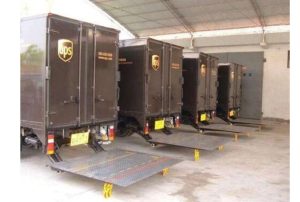 Tuck Away Lift Gate
What Is a Rail Lift Gate?
A rail lift gate uses two vertical rails or columns mounted at the rear of the truck body. The platform travels up and down along those rails. When stowed, the platform usually folds or rests against the rear of the vehicle.
The main advantage is stable vertical movement. A rail liftgate keeps the platform level through the travel path, which helps with tall loads, heavy carts, beverage delivery, food service, tire delivery and street-level unloading. The tradeoff is rear-door access. Because the rails and platform occupy the rear opening, operators may need to lower the gate before reaching cargo.
Rail liftgates are often selected when the route depends on heavy street delivery instead of frequent dock access.
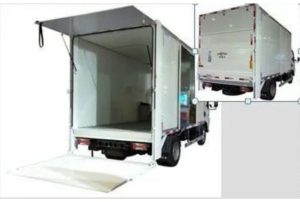 Rail Lift Gate
Tuck Away Lift Gate vs Rail Lift Gate: Quick Comparison
| Factor | Tuck Away Lift Gate | Rail Lift Gate |
|---|
| Stowed position | Folded under the truck body | Against or along the rear body |
| Rear door access | Usually clear when stowed | Often partly blocked when stowed |
| Dock loading | Strong fit because the gate stays out of the way | Weaker fit because the gate can block dock workflow |
| Street loading | Good for mixed freight and flatter ground | Strong for heavy, tall or unstable freight |
| Platform behavior | Often tilts near ground, some level-ride models available | Usually level vertical travel |
| Door compatibility | Often better with swing doors | Often better with roll-up doors |
| Ground clearance | Needs enough space under the body | Less dependent on underbody storage space |
| Common use | Multi-stop delivery, dock-heavy routes, mixed freight | Beverage, food, tire, carts, bulky freight |
| Hydraulic focus | Compact pump package, protected mounting, fast deploy/stow | Stable flow, high-cycle durability, larger platform demand |
The short answer: use a tuck away lift gate when workflow and rear access are the priority. Use a rail lift gate when platform stability and vertical lifting are the priority.
When to Choose a Tuck Away Lift Gate
Choose a tuck-away gate if the truck spends a lot of time at loading docks. Because the platform stores under the body, the driver can back into a dock, open the rear door and load with a dock plate or forklift workflow without the liftgate blocking the opening.
It is also a good fit for high-stop routes. Parcel delivery, light freight, service trucks and mixed urban routes benefit from quick access to the cargo area. The driver does not need to lower a rear-mounted platform every time the door must be opened.
Tuck-away gates are also useful when the truck has swing doors. Heavy Duty Trucking notes that swing-door hinges can interfere with rail-style gates because rails mount near the rear corner posts. In those cases, tuck-away or cantilever designs can be easier to fit.
Check these items before choosing one:
- Does the truck have enough ground clearance for the folded platform and hydraulic power unit?
- Will the platform size handle the cargo, hand truck, pallet jack and operator?
- Does the route include steep driveways or uneven street unloading?
- Is the hydraulic pump protected from road splash, salt and debris?
- Can the battery and cable system handle peak current without major voltage drop?
When to Choose a Rail Lift Gate
Choose a rail liftgate if the cargo needs a larger, flatter and more predictable platform. The vertical travel path is helpful for tall freight, top-heavy carts, beverage stacks, food-service loads and fragile goods that should stay level.
Rail gates are especially strong for street unloading. The platform can provide a stable loading surface when there is no dock, forklift or ramp. This is why many beverage, food, tire and parts delivery routes use rail-style or column-style gates.
Rail gates are not always the best choice for dock-heavy routes. When stowed, the platform and rails can block part of the rear opening. The operator may need to lower the gate just to access cargo, which adds time across many stops.
Before choosing a rail gate, confirm:
- The rear door is a roll-up style or otherwise compatible with rails.
- The platform depth is enough for cargo plus handling equipment.
- The load center is realistic, not just the rated capacity number.
- The route does not require constant dock access.
- The hydraulic and electrical system can support high-cycle operation.
Hydraulic Power Unit Differences to Check
The liftgate frame is only half of the selection. The hydraulic power unit must match the gate geometry, cylinder volume, load, voltage and daily duty cycle.
Hydrath liftgate pump configurations commonly use 12V or 24V DC power, 1.0 to 5.0 L/min flow, pressure up to 16 MPa and 3L to 10L reservoir options. The right configuration depends on actual cylinder size, lifting speed, hose routing and whether the circuit is single acting or double acting.
| Hydraulic Item | Why It Matters | Typical Question |
|---|
| Voltage | Affects current draw and cable sizing | Is the vehicle 12V or 24V? |
| Flow rate | Controls lifting and lowering speed | How fast should the loaded platform cycle? |
| Relief pressure | Limits maximum force and protects the circuit | What pressure is required for rated load? |
| Reservoir size | Supports cylinder volume, oil return and heat control | Is the tank large enough for full stroke movement? |
| Circuit type | Changes valves and cylinder connections | Power up/gravity down or power up/power down? |
| Control method | Affects operator position and safety | Fixed switch, wired pendant or wireless remote? |
| Duty cycle | Affects motor heating and battery sizing | How many cycles per route or per hour? |
For light and medium mobile systems, a 12V DC hydraulic power unit is common. For heavier commercial trucks or frequent cycles, 24V can reduce current for the same power level. If the application uses a power-up and gravity-down circuit, a single acting hydraulic power pack may be enough. If the platform must be driven both up and down, use a double acting valve layout.
The DC motor is also part of the specification. A DC motor for hydraulic power packs should be selected around voltage, power, duty cycle, thermal behavior and starting current.
How to Choose the Right Liftgate and Pump
Use this process before ordering a liftgate or replacement power unit:
- Define the route. Count dock stops, street stops, uneven-ground stops and total cycles per day.
- Define the cargo. Include the heaviest load, load center, packaging, pallet jack, hand truck and operator weight.
- Check the vehicle. Confirm body width, bed height, rear door type, hitch, bumper, underbody clearance and mounting frame.
- Choose gate style. Pick tuck-away for rear access and dock-heavy work. Pick rail for stable vertical lifting and heavy street work.
- Size the platform. Do not use capacity alone. Confirm width, depth, surface, cart stops and ramp behavior.
- Match the hydraulic circuit. Confirm cylinder bore, stroke, oil volume, pressure, flow and reservoir capacity.
- Check the electrical system. Confirm battery capacity, cable length, cable gauge, protection, charging method and voltage drop.
This sequence prevents a common problem: buying a liftgate that fits the load rating but fails the actual route.
Safety and Compliance Notes
Liftgate selection is also a safety decision. OSHA’s trucking loading and unloading guidance states that workers should be instructed in safe procedures appropriate to the material they handle. That principle applies directly to liftgates, where operators work around moving platforms, rolling cargo and truck traffic.
Do not overload the platform. The load rating should include cargo, packaging, pallet jack, hand truck and any person standing on the platform. Heavy Duty Trucking also notes that platform depth and battery power are frequent specification issues. Liftgates can draw high current for short periods, so batteries, cable length and charging time should be planned before the vehicle enters service.
For trailers and certain truck bodies, also review rear impact guard and underride requirements. Maxon lists NHTSA and FMVSS/CMVSS compliant underride device options on some Tuk-A-Way models. Final compliance depends on the vehicle, body builder, liftgate model and installation.
OEM RFQ Checklist for a Liftgate Hydraulic Pump
Send these details when requesting a pump quote:
| RFQ Item | What to Provide |
|---|
| Vehicle power | 12V DC, 24V DC or other |
| Gate style | Tuck-away, rail, column, slider, cantilever |
| Rated load | Load rating and expected real working load |
| Cylinder data | Bore, rod, stroke, quantity and mounting |
| Required speed | Lift time and lowering time target |
| Circuit | Single acting or double acting |
| Pressure | Working pressure and relief valve setting |
| Flow | Target L/min or cycle-time requirement |
| Reservoir | Oil volume and mounting orientation |
| Ports | NPT, BSPP, SAE or custom |
| Controls | Toggle switch, wired pendant, wireless remote |
| Environment | Road salt, rain, cold weather, washdown, dust |
| Duty cycle | Cycles per route, per hour and per day |
With this information, Hydrath can review a compact hydraulic power unit layout instead of guessing from liftgate capacity alone.
Frequently Asked Questions
Is a tuck away lift gate the same as a tuck-under liftgate?
Yes, in most commercial truck discussions the terms are used for the same style. The platform folds and stores under the truck body when it is not in use. Brand names and exact folding geometry can vary by manufacturer.
Is a rail liftgate stronger than a tuck-away liftgate?
Not always. Strength depends on the specific model, rated capacity, structure, cylinders and installation. Rail liftgates often provide a larger level platform, while some tuck-away models also handle high capacities.
Which liftgate is better for loading docks?
A tuck-away liftgate is usually better for dock loading because it stores under the body and keeps the rear opening clear. This allows normal dock-plate or forklift workflow when the liftgate is not needed.
Which liftgate is better for heavy carts and tall loads?
A rail liftgate is often better for heavy carts and tall loads because it provides straight vertical travel and a level platform. This helps keep unstable freight more predictable during lifting and lowering.
Do tuck-away and rail gates use the same hydraulic pump?
They can use similar DC hydraulic power unit technology, but the exact pump, valve, tank and motor selection should match the cylinder volume, flow demand, load, duty cycle and control logic. Do not select the pump by liftgate type alone.
Should I choose a 12V or 24V liftgate power unit?
Choose 12V when the vehicle electrical system is 12V and the duty cycle is moderate. Choose 24V when the truck platform supports it and you want lower current for the same power. Heavy-use routes may also need auxiliary batteries or charging support.
Closing
A tuck away lift gate and a rail lift gate solve different route problems. Tuck-away designs keep the rear opening clear and work well for dock-heavy, high-frequency delivery. Rail designs give a larger, level platform and suit heavy street unloading.
Once the gate style is chosen, the hydraulic power unit must be specified with the same care. Voltage, flow, pressure, tank size, control type, duty cycle and cable layout determine whether the liftgate feels fast, stable and reliable in daily service.
For OEM liftgate projects or replacement power units, Hydrath can help review compact 12V/24V hydraulic liftgate pump options for tuck-away, rail and other vehicle-mounted lifting systems.