What Is a Truck Liftgate Hydraulic Power Unit?
A truck liftgate hydraulic power unit is a compact DC hydraulic system that converts battery power into oil flow and pressure for a rear loading platform. It drives the hydraulic cylinder that raises the platform from ground level to truck-bed height, holds it during loading, and controls lowering through a valve circuit.
In a complete liftgate system, the power unit is not the visible platform. It is the working source behind the motion. The platform, frame, hinge arms, and cylinders handle the mechanical movement. The hydraulic power unit supplies the pressure and flow that make the movement possible.
For OEM and maintenance teams, this distinction matters. A liftgate can have the right platform and frame but still perform poorly if the pump flow is too low, the relief setting is wrong, the reservoir is undersized, or the battery wiring cannot handle peak current.

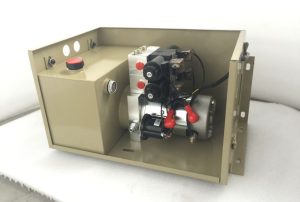 Truck Liftgate Hydraulic Power Unit
How a Hydraulic Truck Liftgate Works
- The operator presses a control switch, pendant, or wireless remote.
- The contactor or relay energizes the DC motor.
- The motor drives a gear pump.
- The pump draws oil from the reservoir and sends flow through the manifold.
- Oil enters the hydraulic cylinder and raises the platform.
- The relief valve limits maximum system pressure.
- During lowering, a valve opens to meter oil back to the tank.
- The platform returns to ground level under controlled hydraulic flow.
Many liftgates use a power up and gravity down circuit. In that layout, the pump raises the platform, while descent depends on gravity and a normally closed lowering valve. Other systems use a double acting cylinder, where hydraulic pressure controls both raising and lowering. The right choice depends on platform geometry, load behavior, safety requirements, and cost.
Main Components of a Liftgate Hydraulic System
A liftgate is a mechanical and hydraulic system, not just a platform. The table below shows the main components and why each one matters.
| Component | Function | Selection Notes |
|---|
| Platform | Carries cargo during lifting and lowering | Match width, depth, surface, and rated load to the vehicle |
| Mounting frame | Connects the liftgate to the truck chassis or body | Check frame strength, corrosion protection, and installation space |
| Hinge arms or rails | Guide platform movement | Tuck-under, rail-style, fold-up, and cantilever gates use different layouts |
| Hydraulic cylinder | Converts oil pressure into lifting force | Size bore, rod, and stroke to load and geometry |
| DC motor | Drives the hydraulic pump | Choose 12V, 24V, or 48V based on vehicle power and current limits |
| Gear pump | Creates hydraulic flow | Flow controls speed, pressure capability must match the load |
| Reservoir | Stores hydraulic oil | Size for cylinder volume, return flow, cooling, and de-aeration |
| Manifold block | Integrates valves and ports | Reduces hoses and helps keep the circuit compact |
| Relief valve | Limits maximum pressure | Set below the rated limit of cylinder, hoses, and structure |
| Lowering valve | Controls descent | Critical for power up/gravity down circuits |
| Control switch | Sends up/down commands | Can be toggle, wired pendant, cab switch, or wireless remote |
| Wiring and protection | Carries high current safely | Cable size, fuse, relay, and ground path affect reliability |
Common Liftgate Types and Hydraulic Requirements
The liftgate type affects cylinder layout, mounting room, oil volume, and control logic. A power unit should be selected after the mechanical style is known.
| Liftgate Type | Typical Use | Hydraulic Notes |
|---|
| Tuck-under liftgate | Box trucks, delivery trucks | Compact mounting, platform folds under the rear body, often uses compact DC power units |
| Rail-style liftgate | High-cycle freight and delivery work | Platform moves along vertical rails, may need stable control and heavier duty wiring |
| Fold-up liftgate | Trucks that need a full rear platform | Larger platform area, check cylinder oil volume and tank capacity |
| Cantilever liftgate | Heavy or uneven loading conditions | Better platform angle control, often needs more careful cylinder and valve selection |
If the platform is light and gravity lowering is consistent, a single acting circuit may be enough. If the gate must lower under better control, work in uneven conditions, or handle different platform angles, a double acting circuit may be worth the added cost and complexity.
12V vs 24V Liftgate Power Units
Voltage is one of the first decisions in a mobile liftgate power unit. The correct answer usually follows the vehicle electrical system. A 12V truck normally uses a 12V power unit. A 24V commercial vehicle normally uses a 24V power unit. Problems start when the power unit, battery, alternator, cable length, and duty cycle are treated separately.
| Feature | 12V Liftgate Power Unit | 24V Liftgate Power Unit |
|---|
| Common vehicle fit | Light trucks, vans, retrofit kits | Commercial trucks, heavier mobile systems |
| Current draw | Higher current for the same power | Lower current for the same power |
| Cable sensitivity | More sensitive to voltage drop | Better for longer cable runs |
| Heat in wiring | Higher if cable is undersized | Lower at equal power |
| Availability | Broad in light-duty aftermarket | Common in commercial vehicle systems |
| Best fit | Lower cycle rate and smaller platforms | Higher duty, heavier load, longer wiring |
For the same motor power, current is roughly power divided by voltage. A 2.2 kW motor at 12V draws far more current than the same power at 24V. Real systems also need to consider start-up current, pressure rise, cable length, battery condition, and duty cycle. This is why a liftgate may work during a short shop test but fail in delivery use.
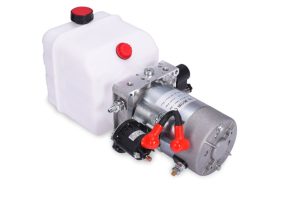 12V liftgate pump
Single Acting vs Double Acting Liftgate Circuits
A liftgate circuit should match the way the platform moves. Most compact systems use either single acting or double acting logic.
| Feature | Single Acting | Double Acting |
|---|
| Motion | Power up, gravity down | Power up, power down |
| Cylinder ports | Usually one pressure port | Two ports |
| Lowering control | Lowering valve meters return flow | Directional valve controls both sides |
| Cost | Lower | Higher |
| Plumbing | Simpler | More hoses and ports |
| Best use | Standard liftgates with reliable gravity descent | Gates needing controlled lowering or bidirectional force |
| Common issue | Descent speed depends on load and valve setting | More parts to troubleshoot |
Single acting systems are popular because they are simple. The pump sends oil to raise the platform, and the lowering valve releases oil back to the tank. Double acting systems add more control but require a matched cylinder, valve logic, and plumbing.
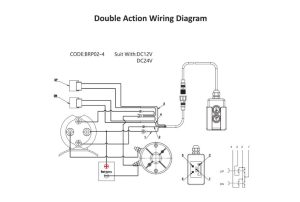 Truck Liftgate Hydraulic Power Unit circuit
How to Size Pressure, Flow, and Reservoir Volume
Sizing a liftgate hydraulic power unit starts with the load and motion requirement. Do not choose a pump only by motor voltage or tank size.
- Define platform load. Include the rated cargo weight, platform weight, and safety margin.
- Check the lift geometry. Cylinder force depends on bore area and linkage geometry, not only system pressure.
- Set pressure range. Many compact tail lift power packs work around 160-200 bar, but final relief pressure must match the cylinder, hoses, frame, and OEM rating.
- Choose pump flow. Flow controls lifting speed. Higher flow gives faster movement, but it requires more motor power and battery current.
- Size the reservoir. Tank volume must cover cylinder oil demand, return flow, de-aeration, heat, and mounting orientation.
- Confirm duty cycle. A short-cycle delivery truck and a low-frequency service vehicle do not need the same thermal margin.
- Validate wiring. Cable size, fuse rating, relay capacity, and ground quality must fit peak current, not just average current.
A practical starting point for OEM discussion is to share the target platform capacity, cylinder bore and stroke, expected lift time, voltage, operating temperature, and mounting envelope. With these inputs, the supplier can calculate pump displacement, motor power, tank volume, and valve arrangement.
OEM RFQ Checklist for a Liftgate Power Unit
A clear RFQ reduces redesign and prevents mismatched parts. Use the checklist below before asking for a liftgate power unit quote.
| RFQ Item | What to Provide |
|---|
| Vehicle type | Box truck, delivery truck, trailer, service body, commercial truck |
| Power supply | 12V, 24V, or 48V DC, battery capacity, cable length |
| Platform data | Rated load, platform size, platform weight |
| Cylinder data | Single or double acting, bore, rod, stroke, mounting points |
| Target speed | Desired lifting and lowering time |
| Pressure | Working pressure and maximum relief setting |
| Flow | Required flow or target cylinder speed |
| Reservoir | Preferred volume, material, horizontal or vertical mount |
| Ports | BSPP, NPT, SAE, or metric thread requirement |
| Control | Pendant, toggle switch, cab control, wireless remote |
| Environment | Temperature, road salt, water exposure, dust, vibration |
| Duty cycle | Cycles per hour, run time, cooling time |
| Documentation | Datasheet, hydraulic schematic, wiring diagram, test report |
For Hydrath projects, the most useful first message is not “send price for liftgate pump.” A better request is: “24V DC liftgate power unit, single acting, 180 bar relief, target 4 L/min, 8 L reservoir, horizontal mount, BSPP ports, wired pendant, delivery truck use, 20 cycles per hour.” That gives engineering and sales enough information to respond with a practical configuration.
Common Problems and First Checks
Liftgate faults often look hydraulic at first, but the root cause can be electrical, mechanical, or contamination-related. Start with simple checks before replacing expensive parts.
| Symptom | First Checks |
|---|
| Motor runs but platform does not lift | Oil level, pump coupling, suction path, relief valve, load weight |
| Motor does not run | Battery voltage, fuse, relay, switch, ground cable |
| Platform lifts slowly | Low battery, undersized cable, worn pump, low flow, cold oil |
| Platform lowers too fast | Lowering valve setting, load condition, flow control |
| Platform will not lower | Lowering valve coil, control signal, blocked return path |
| Platform drifts down | Check valve, cylinder seal, valve leakage |
| System overheats | High duty cycle, small reservoir, relief valve bypass, low oil level |
Always secure the platform, disconnect power where needed, and release pressure before service. For fleet work, keep a simple log of oil changes, filter checks, electrical repairs, and valve adjustments. Repeated small faults often point to a sizing or wiring issue rather than a single bad component.
Frequently Asked Questions
What is the difference between a liftgate and a tail lift?
Liftgate and tail lift usually describe the same type of rear vehicle lifting platform. “Liftgate” is common in North American usage, while “tail lift” is more common in Europe and other markets.
What size hydraulic pump do I need for a liftgate?
The pump size depends on cylinder volume, target lifting speed, system pressure, and motor power. Flow controls speed, while pressure relates to load force. For compact tail lift power packs, many projects start around 3-5 L/min and 160-200 bar, but final sizing must follow the liftgate geometry and OEM rating.
Should I choose a 12V or 24V liftgate power unit?
Choose the voltage that matches the vehicle electrical system first. If both are possible, 24V is usually better for higher power, longer cable runs, and heavier duty use because it reduces current for the same power. 12V remains common for light trucks, vans, and retrofit kits.
What is a power up and gravity down liftgate?
Power up and gravity down means the hydraulic pump raises the platform, while lowering happens by gravity through a controlled valve. This layout is common because it is simple and cost-effective, but descent speed depends on load, valve setting, oil temperature, and platform condition.
Why does my liftgate motor run but the platform will not lift?
Common causes include low oil level, blocked suction, worn pump, incorrect relief valve setting, damaged coupling, low battery voltage, or a load beyond the rated capacity. Check oil, battery voltage, wiring, and pressure before replacing the power unit.
What information does Hydrath need to quote a custom liftgate power unit?
Hydrath needs the vehicle voltage, platform load, cylinder data, target lifting time, pressure range, flow rate, reservoir requirement, port thread, mounting direction, control method, duty cycle, and environment. Photos, drawings, and wiring requirements help shorten the selection process.