Understand how hydraulic pumps and motors convert energy, differences between LSHT and HSLT motors, and how to choose components for real-world applications.
What is a Hydraulic Pump?
A hydraulic pump converts mechanical energy from a prime mover into hydraulic energy as oil flow and pressure. It must overcome the load’s pressure to deliver the required flow. Common types are gear, vane, and piston pumps, with axial-piston pumps used widely for high-pressure systems.
Gear Hydraulic Pump Axial-Piston Pump What is a Hydraulic Motor?
A hydraulic motor is a rotary actuator that converts hydraulic energy back into mechanical energy. Its torque and speed are determined by pressure drop and flow. Power output is proportional to speed, so flow control directly influences motor performance.

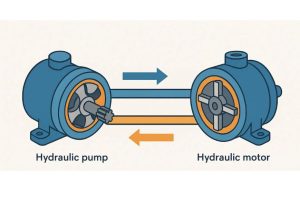 Hydraulic Pump VS Hydraulic Motor
How Pumps and Motors Work Together
- The prime mover drives the pump, which generates oil flow at system pressure.
- The motor receives this fluid energy and converts it into rotational motion.
- Valves regulate direction and speed, and a reservoir maintains fluid supply and heat dissipation.
- Typical applications include lifts, conveyors, mobile equipment, and amusement rides.
LSHT vs HSLT Hydraulic Motors: Selection Guide
LSHT (Low-Speed, High-Torque)
- Delivers high torque at low speeds
- Suits heavy-duty starts, mobile equipment, winches
- Often larger displacement; robust for shock loads
HSLT (High-Speed, Low-Torque)
- Operates at higher speeds with lower torque
- Fits fans, pumps, and applications needing compact high RPM
- Requires careful matching of bearings and cooling
LSHT vs HSLT: Selection Comparison
| Criteria | LSHT (Low‑Speed, High‑Torque) | HSLT (High‑Speed, Low‑Torque) |
|---|
| Torque at speed | High torque at low RPM | Lower torque at high RPM |
| Typical applications | Winches, mobile equipment, heavy starts | Fans, pumps, compact high‑RPM drives |
| Displacement | Larger displacement | Smaller displacement |
| Pressure rating | High pressure capable | Moderate pressure; high‑speed rating |
| Speed range | Optimized for low speed | Optimized for high speed |
| Control behavior | Stable load‑holding and low‑speed control | Precise speed control; limited low‑speed torque |
| Cooling/filtration | Watch heat under throttling; robust to shock | Heat management critical at high RPM |
| Mounting/shaft | Heavy‑duty flange and shaft | Compact flange; high‑speed shaft tolerances |
Conclusion: Choose LSHT for heavy torque at low speeds; choose HSLT for high‑speed, lower‑torque applications.
Pros and Cons
Advantages
- High power density compared to mechanical systems
- Precise speed/torque control via valves and flow
- Modular: pump, motor, valve, reservoir configured per application
Disadvantages
- Sensitivity to contamination; filtration is critical
- Heat generation at throttling; efficiency depends on control strategy
- Requires correct sizing for pressure, flow, and duty cycle
LSHT vs HSLT: Pros and Cons
| Aspect | LSHT | HSLT |
|---|
| Advantages | High starting torque; shock load tolerance; stable low‑speed control | Compact size; high RPM capability; efficient at speed |
| Disadvantages | Bulkier; lower max RPM; heat under throttling | Lower torque; bearing/cooling requirements; more sensitive at high RPM |
Frequently Asked Questions
What’s the difference between a hydraulic pump and a regular pump?
A regular pump maintains fluid transfer at near-constant flow, while a hydraulic pump must overcome load pressure to supply controlled flow and pressure for actuators.
How do I choose between LSHT and HSLT motors?
Start from the load’s torque-speed profile. LSHT suits heavy torque at low speed; HSLT suits high speed with lower torque. Check displacement, pressure rating, and cooling.
Which pump type should I use?
Gear pumps for simplicity and cost, vane pumps for moderate pressure with good efficiency, axial-piston pumps for high pressure and variable flow.
How does flow relate to motor speed?
Speed is proportional to flow at a given displacement; torque depends on pressure drop. Balance both to meet power requirements.
What standards should I consider?
Follow ISO 4413:2010 for hydraulic system design; consider ATEX in explosive atmospheres. Verify pressure, temperature, materials, and certifications.